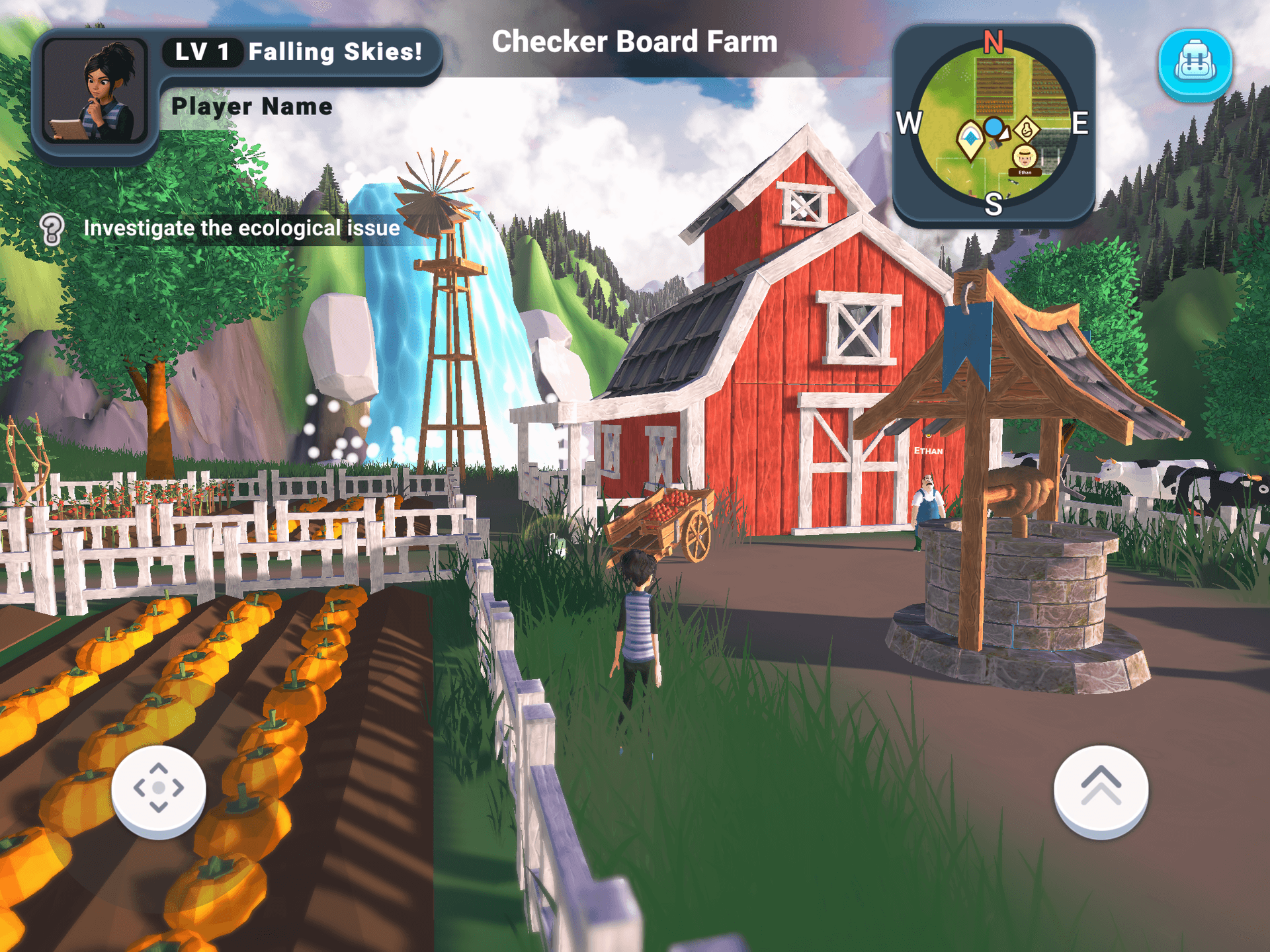
ALIVE
Agency in Learning, Immersive & Virtual Environments
The ALIVE project investigates how learners exercise agency in immersive and virtual environments. Grounded in a theoretical framework of learner agency as a capacity shaped by context, the project examines the design conditions — in both digital and physical environments — that enable learners to act with intention, persistence, and critical awareness. The lab brings together graduate students, postdoctoral fellows, and community partners at UBC.
Supported By
 Social Sciences and Humanities Research Council
Guiding Questions
Research Questions
- 1
How do learners exercise and develop agency in postdigital learning environments?
- 2
What design conditions in virtual and immersive environments support the emergence of learner agency?
- 3
How can agency be reliably measured across diverse educational contexts?
Approach
Methods Overview
Mixed-methods design combining experimental and quasi-experimental studies in virtual inquiry environments, psychometric development of agency measures, and qualitative analysis of learner experience. Game-based assessments and learning analytics provide novel windows into the emergence of agency in real time.
Directed by Jillianne Code with graduate students and postdoctoral fellows from the Department of Curriculum & Pedagogy at UBC.
People
Project Team

Jillianne Code, PhD
Principal Investigator
Canada Research Chair & ALIVE Lab Director

Nick Zap, PhD
Co-Investigator
Adjunct Professor, Curriculum Studies

Rachel Ralph, PhD
Co-Investigator
Faculty, Centre for Digital Media
Aashay Mehta, MDM
Producer
Game Development Coordinator, CDM

Aimee Lutrin, MA
Research Coordinator
PhD Student, Curriculum Studies
Nesrine El Banna, PhD Candidate
Research Assistant
PhD Student, Curriculum Studies
Rachel Moylan, PhD Candidate
Research Assistant
PhD Student, Curriculum Studies
- Strategic
- steady and deliberate action across data sources
- Mismatched
- observed agency and self-perceived agency did not align
- Emerging
- consistent procedures and some intentionality
- Intuitive
- strong causal insight in think-alouds but did not use systematic strategies
Outputs
Publications
2026
Code, J., Forde, K., Moylan, R., Lutrin, A., Tasabehji, Z., Ralph, R., Mehta, A., Zap, N., & El Banna, N.
Computers & Education
DOI →Postdigital Learner Agency: Navigating Hybrid and Algorithmically Mediated Education
Code, J. (Ed.)
Springer Nature Switzerland
2025
The entangled learner: Critical agency for the postdigital era
Code, J.
Postdigital Science and Education, 7, 336–358
DOI →2020
Code, J.
Frontiers in Education, 5(19), 1–15
DOI →2012
Thinking outside the bubble: Virtual performance assessments for measuring inquiry learning
Clarke-Midura, J., Code, J., Mayrath, M., Dede, C., & Zap, N.
In Technology Based Assessment for 21st Century Skills: Theoretical and Practical Implications from Modern Research. Information Age Publishing.
Virtual performance assessment in immersive virtual environments
Code, J., Clarke-Midura, J., Zap, N. & Dede, C.
In H. Wang (Ed.), Interactivity in E-Learning. IGI Publishing.
DOI →2009
Self-regulated learning in video game environments: Implications for educational gaming
Zaparyniuk, N., & Code, J.
In Handbook of Research on Effective Electronic Gaming in Education. IGI Publishing.
DOI →2007
Examining trace data to explore self-regulated learning
Hadwin, A. F., Nesbit, J. C., Jamieson-Noel, D., Code, J., & Winne, P. H.
Metacognition and Learning, 2(2), 107–124
DOI →2006
Using Cognitive Tools in Gstudy to Investigate How Study Activities Covary with Achievement Goals
Nesbit, J. C., Winne, P. H., Jamieson-Noel, D., Jillianne Code, M. Z. K. M. A. S. B. W. W., & Hadwin, A.
Journal of Educational Computing Research, 35(4), 339–358
DOI →
Explore the full research program
All active and completed projects, research statement, and the ALIVE Lab.