
Research Note #4
Four Questions That Changed How I Think About AI
We don't need better opinions about AI. We need better questions.
Convenience has never been more valuable.
Neither has thinking.
Artificial intelligence promises more of the first.
The conversation has focused almost entirely on what AI can do.
Can it write?
Can it summarize?
Can it tutor?
Can it generate ideas?
Can students use it?
Should instructors allow it?
These are important questions.
I don't think they are the most important ones.
Over the past year, I've come to realize that much of the public conversation about AI has focused on the technology.
Far less attention has been given to the learner.
That shift changed the way I think about AI.
I no longer begin by asking whether someone used AI.
Instead, I ask a different question.
What kind of agency does this activity develop?
That single question changes everything.
It moves the conversation away from the technology and back to the human being using it.
To help myself answer that question, I've started using a simple tool.
I call it the Agency Test.
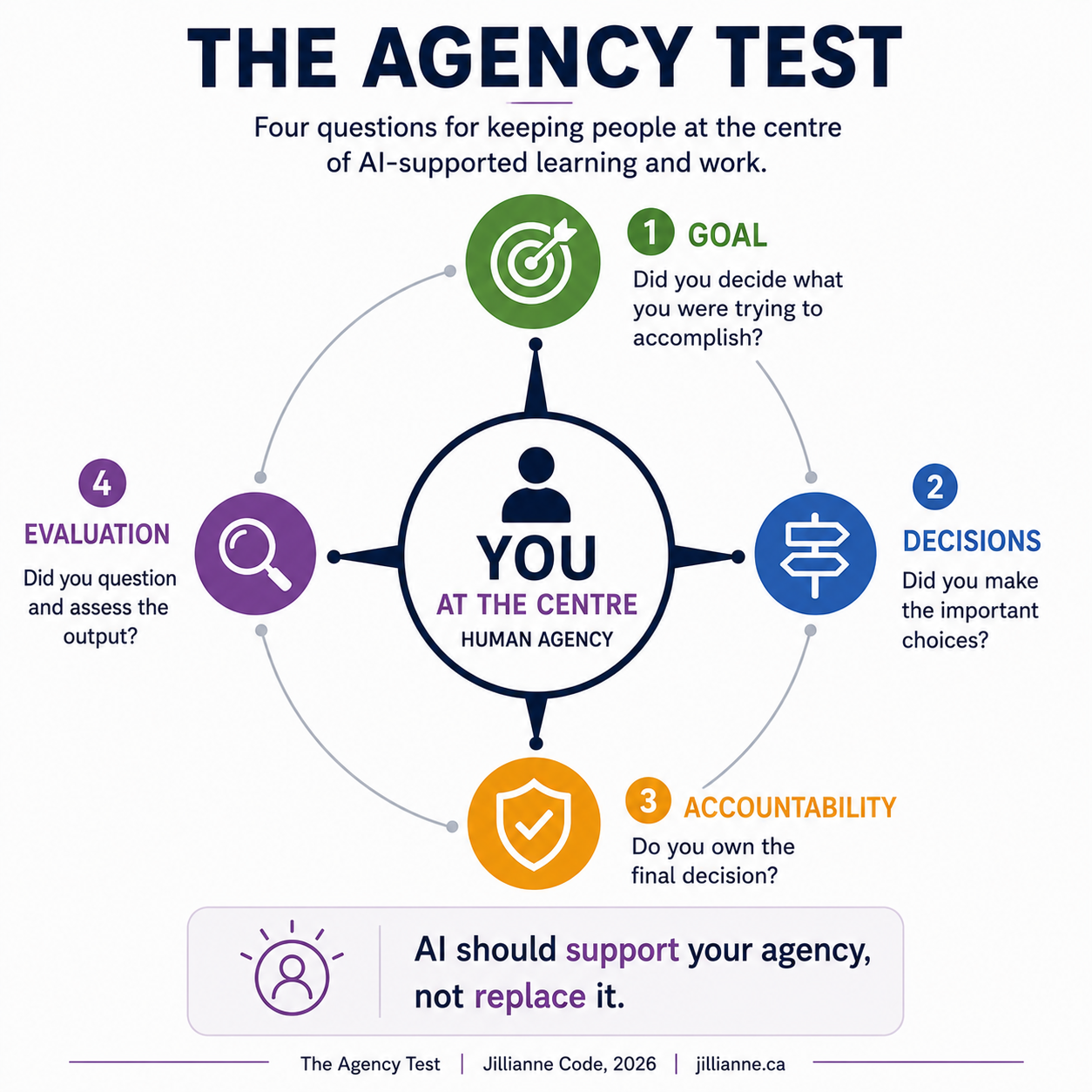
Whenever I see AI used in a learning activity, I ask four questions.
1. Who sets the goal?
- Did the learner define what they were trying to accomplish?
- Or did AI determine the direction?
2. Who makes the important decisions?
- Who exercised judgment?
- Who weighed alternatives?
- Who decided what mattered?
3. Who evaluates the work?
- Did the learner critically examine the output?
- Or was AI treated as the authority?
4. Who remains accountable?
- Who owns the final decisions?
- Who accepts responsibility for the outcome?
Notice what these questions do.
None of them ask whether AI was used.
Instead, they ask whether the learner remained an active participant in the thinking.
That distinction matters.
Imagine two students writing the same paper.
The first asks AI to generate a draft, edits a few sentences, and submits it.
The second uses AI to challenge assumptions, identify missing evidence, generate counterarguments, and refine ideas before writing the paper themselves.
Both students used AI.
One delegated the thinking.
The other expanded it.
The difference isn't the technology.
The difference is agency.
That same test extends well beyond education.
Healthcare professionals increasingly work alongside AI.
Researchers use AI to organize literature and analyze data.
Professionals use AI to draft reports, summarize meetings, and support decision-making.
The question isn't whether AI should be part of those activities.
It already is.
The better question is whether people continue to exercise judgment, reflection, and responsibility while using it.
That question sits at the centre of my research on postdigital learner agency.
I'm becoming less interested in whether AI makes us more efficient.
Efficiency is easy to measure.
Agency is much harder.
The future of education won't be determined by whether students use AI.
It will be shaped by whether we continue designing learning experiences that require people to think, decide, question, and remain accountable.
Perhaps that is the hidden cost of convenience.
Convenience isn't the problem.
The problem is when convenience becomes a substitute for the kinds of thinking that develop human agency.
I don't think we need better opinions about AI.
I think we need better questions.
Question for Reflection
The next time you use AI, don't begin by asking what it helped you produce.
Ask yourself something different.
Who did the thinking?
Dive Deeper
If this Research Note resonates with you, these publications explore these ideas in greater depth.
The Entangled Learner: Critical Agency for the Postdigital Era
Introduces the Postdigital Learner Agency (PLĀ) framework and examines how agency emerges through relationships among people, technologies, and institutions.
https://doi.org/10.1007/s42438-025-00544-1
Agency for Learning
Introduces the Agency for Learning framework and examines agency through intentionality, forethought, self-regulation, and self-reflection.
https://doi.org/10.3389/feduc.2020.00019
Expressions of Learner Agency in Virtual Inquiry
Drawing on the ALIVE project, this forthcoming paper explores how learner agency is expressed within immersive inquiry environments.